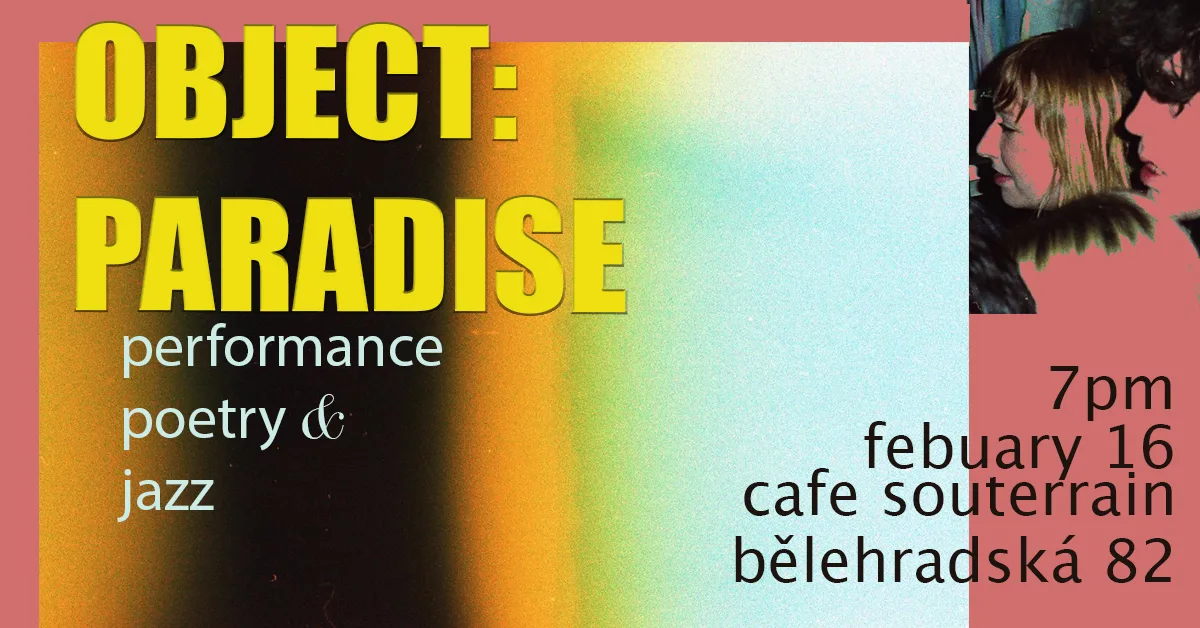
February 16 2019 @ Večerní kavárna Souterrain
Architecture of Poetry was the second language happening curated by OBJECT:PARADISE, taking place on February 16th 2019 at Večerní kavárna Souterrain, Prague. The curation set out to stage language as a built environment, collecting objects for actions that would happen concurrently — typing, eating, slicing, brushing, reading — so that a sentence could be entered the way a building is entered, and the listener would leave as the architect of whatever they had heard. Throughout the evening, participants witnessed concurrent action and improvised piano assemble into a single, eventual structure of language.
An eventual rhythm: a recount of Architecture of Poetry
Written by Tyko Say, July 26, 2026
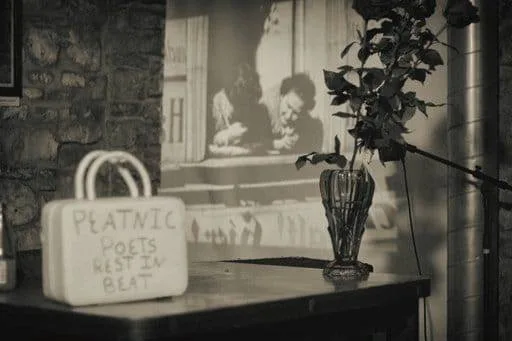
The room is the effect of a staircase you descend into. Prague in the middle of February, and below the street the musky student cellar of Souterrain: wooden chairs with uneven legs stuck in beer, a bartender who does not want to be there, the small smell of weed. On and around the stage table sits the evening’s inventory, waiting on its verbs — six balloons hanging, a black plague mask, a bouquet of flowers, a tupperware of spaghetti, a toothbrush, a broken typewriter, a slab of ham, and a video of a woman giving birth to the universe. A rectangle of red slavic carpet sits under a keyboard, and at 8pm nobody has said the word poetry yet.
Jenda Pudlák presses his fingers to the keyboard and the first chord clears its throat. Tyko Say leaves the barstool wielding an electric toothbrush, stands before the microphone, and recites through a foaming mouth —
Smíchov,
Smíchov…
— the brush still working the molars mid-line.
Jaromír Lelek begins, crosses to the Aristocrat, and sticks his fist in it. He types his shopping list — halušky and sausage — and the clack of the levers dots the ends of the sentences at the mic until the sound of it happening becomes a language of its own. The bartender serves zelený to students walking in off the stairs, trying to understand if what is happening is supposed to happen.
Jenda answers with a slide and a dabble. Céline Dubois, in the black plague mask, dips and twists her fork around the tupperware noodle at the stage table, eating it like a percussion instrument, while Jeff Milton stands at her side slicing the ham. The room starts keeping time with itself — a girl writes something on the back of a beer coaster, flips it over, and turns her glass 90 degrees directly into the gullet.
Jeff hands Tyko Say a cut of ham. Tyko examines it, turning it over and over, holds it up like a page, and reads Robert Creeley’s I know a man off the marbling while Jenda wails with diamonds under his eyebrows, glistening like the lights of buildings you see from afar at the overpass. Back at the mic he asks, “So what is poetry?” — then snatches the bouquet of flowers from the table and drinks from its bottle.
Jaromír pulls his fist out of the typewriter and replaces him on the stage, stands a moment beating the audience down with a stance, then grabs the hanging balonky by the throat and fills his lungs with the buoyant air. “First you inscribe, describe, unscribe, ignite it.” The crowd hoots at the pitch shift, but they listen, too.
Céline forks the noodles in and the plague mask fogs on the inside with laughter. Jeff, beside her, lays thinner and thinner slices of Prague ham on a plate like documents waiting to be notarized, and in the front row a girl squinting at the marbling whispers to the girl with the beer coaster, “She must be really hungry.” Both of them giggle, reminded only at moments that they are — or aren’t — at a poetry reading.
Tim Postovít reads next, then An Nguyen, then Vit Bohal, each stepping up, taking the mic or the center of the room, and dropping their pieces straight into Pudlák’s rhythm puddle. They don’t have to do much more than that; Jenda does the rest, doodling to the pause of every comma.
Towards the end of the momentum nothing really ends or wants to. Six readers with six mouths and twelve eyes get up and begin reading simultaneously, and the cadence and accent of balonky, spoken separately, comes together as a unified, eventual rhythm. Jenda finds it — three notes, then four — and then he breaks it, and the night closes as an exhibition of Czenglish slopped in beer, metro stations, and ham.
Back up the staircase, out in the February street, Céline bends over the pavement and gives the spaghetti back. A boy in a haircut nudges over and pivots right to avoid the splash; Tyko Say pivots right with him, and they do that awkward, kind of laugh. “What exactly was all of that?” he asks. A drag on a cigarette: “I’m glad you asked.” Behind them the question stands on the street like a building being blown up from a balonky, the scaffolding its dressing.
Credits