We're cleaning the mold from our VHS tapes to be displayed in a brand new archive of all things OBJECT:PARADISE. Regular programming resumes on opening night.
No code yet? Leave your email above and we will remind you when the archive opens.
On 16-06-2026, we were notified of the permanent deletion of the OBJECT:PARADISE YouTube channel. In a single, automated sweep, our archive of the Prague underground's history, poetics, and experimental film was erased. Furthermore, we have been explicitly prohibited from creating any future channels.
Under the EU's Digital Services Act (DSA), platforms of this scale are legally required to provide transparent moderation, clear justifications, and access to actual human review when a digital livelihood or archive is destroyed. However, even after consultation with agencies operating under the DSA, we have been unable to reach any human response from YouTube.
But as frustrating as this news is, it didn't surprise us.
In fact, it is the exact reason we formed the OBJECT:PARADISE collective in the first place — to curate and create collective agency in the celebration of public art. Today's platforms steal this agency from us through their algorithmic biases and automated content control, which directly conflicts with our Manifesto. So we decided to take the L and to do something with it.
We have completely redesigned the OBJECT:PARADISE Archive with four objectives in mind:
to preserve the entire archive — our films, our magazines, our sounds, and documentation of our curations.
to share the archive in an accessible, O:P way which encourages discovery and users' agency.
to celebrate the users who have contributed to the archive by creating a visual representation of our network's connections and contributions.
to encourage future collaboration within the local and extended O:P network.
And, perhaps most importantly, to keep it free, algorithmically independent, and weird.
In 08-2026, we launched the beta version of the site to select users. The official launch is on 31-10-2026 at The Prague Microfestival, Kampus Hybernská, doors at 18:00.
Thanks for all the support.
—OBJECT:PARADISE
Would you like to get involved or think you can give us a hand in some capacity? Shoot us an email here: info@objectparadise.com
Written in the Independent Republic of Žižkov in 2020 — twenty mantras that guide every OBJECT:PARADISE happening.
Everything can be art, poetry, poetic. Yet, non-art must exist for art to exist.
The OBJECT:PARADISE Manifesto · ver. 16.10.26
OBJECT:PARADISE exists to promote the subject in subjectivity. We believe that quality in expression is native to the moment and dependent on the individual within that moment. Our objective is to celebrate these moments as collective opportunities where all subjects and subjectivities are valued.
We call ourselves a poetics collective because the poetic is a subjective response that happens before something is codified and genrefied, before something is labeled or prescribed a quality, before what is poetic becomes poetry. But poetry is the result of what was poetic—so whose poetic?
Attempts at answering what poetry is (or isn’t) rely on the social forces that shape—and restrict—language itself. Each label and name for expression may be relevant, important, valuable, or even profitable. But, what if, instead, we prioritized the opportunity of expression as an opportunity for the poetic as opposed to the product of a poetry?
Our objective is for us to become more attuned to this opportunity—actively and inductively engaging with the potential poetic. But we must first be provided the opportunity to subject ourselves to it, asking, “Is this a poetry reading? Might I find this poetic today?”
The answer depends on the moment in which the question is asked.
The only constant is change; a single moment can never be replicated—nor can any experience. All expression exists within a new context each time it happens, presenting a new opportunity to experience subjectively.
From the MOMENTUMENT zine.
Yet, this is a radical idea. Conservatism in genre attempts to preserve the time and place in which past members of that culture existed. We idealize convention not for what it is, but for the effect that it had. But whose effect? The convention and the effect can be taught, enforced, and sold as a product. But the moment that produced that effect no longer exists. So whose poetic becomes the product? Whose perspective becomes the subjective?
Everything can be art, poetry, poetic. Yet, non-art must exist for art to exist. We believe these distinctions belong to the individual subject, and should be allowed to change, dependent on the changing contexts in which we exist. What is “objectively good” to one subject may be “objectively bad” to another. Past experiences, convention, culture, and identity may inform our expectations, but should not prescribe our experiences.
OBJECT:PARADISE applies this understanding to the arts: rather than preserving and enforcing a past product, we foster opportunities where the distinction between what is and isn’t poetic belongs entirely to the individual in the moment.
Everything can be art, poetry, poetic. Yet, non-art must exist for art to exist.
The constant of change is innate, ongoing, and objective. To recognize the objective moment is to understand that we do, and can, exist newly within each space and time that we experience. The changing moment is the only thing we can objectively share: the opportunity to subjectively experience together.
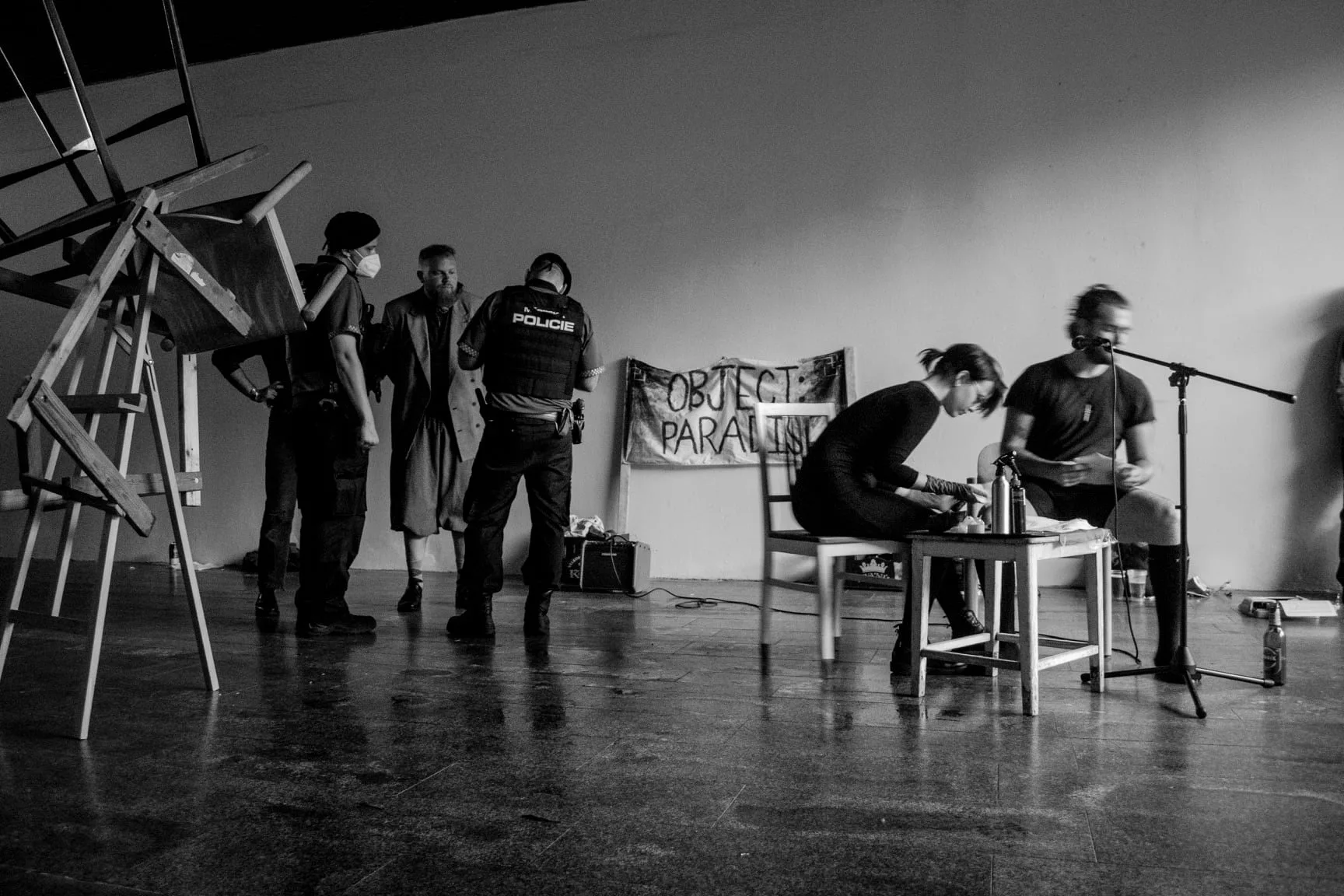
To share a moment is also to occupy the space in which it happens. But spaces create expectations—where a stage is, a performance; where the chairs are, a performance. The arrangement of stage and chair prescribes these expectations. And the announcement that a performance will happen announces that a performance is not already happening.
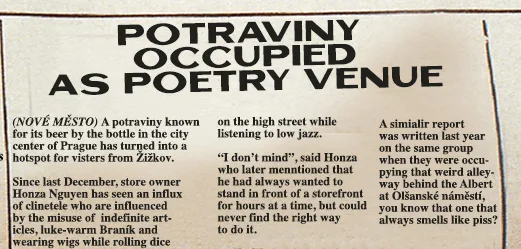
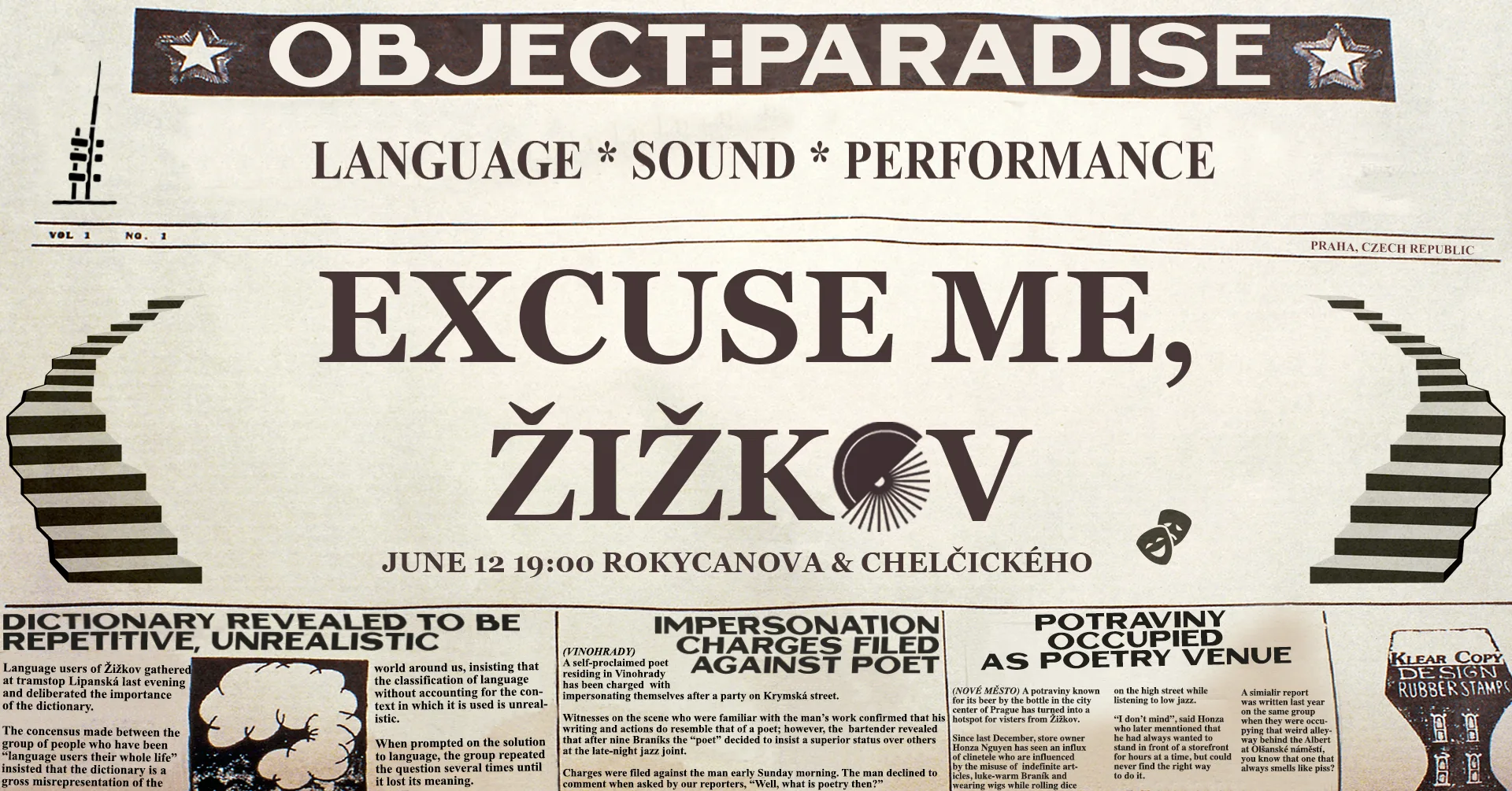
“Potraviny occupied as poetry venue.” From the Excuse Me, Žižkov paper.
Yet the space that provided an opportunity for poetry last evening may not provide the poetic in the morning. The significance depends on the context and those who experience it. This is clear when we think about our language choices; why is it that we can experience the same poem at both a wedding and a funeral differently? Did the speaker really see two paths diverge in a wood? And what does that choice mean when taking a hand in marriage versus a hand in the casket?
All of what has been said can, and will, continue to happen. Context provides the opportunity for connotation, and both context and ourselves within it are changing. OBJECT:PARADISE challenges the prescribed expectations of stage and chair, treating physical space not as a static container for a product, but as the immediate context we objectively share.
The changing moment is the only thing we can objectively share.
III. Implication, (Mis)communication, and the Inside Joke
Because expression is always happening for the first time, we aim to release it from its intention and foster a space where it can exist as its implication.
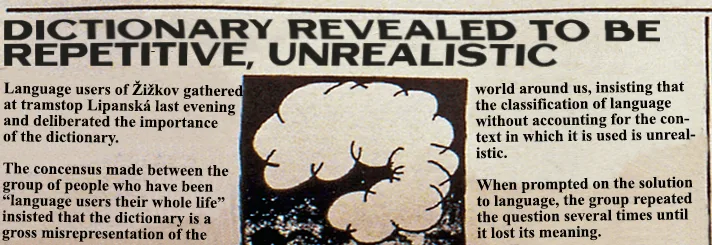
“Dictionary revealed to be repetitive, unrealistic.” From the Excuse Me, Žižkov paper.
The dictionary does not create language; it codifies and anthologizes what has already happened. That codification can then be cited, taught, enforced, corrected, and used to qualify language against the language user. When we erase the restraints of our denotation, the superego of language, we find that we cannot prescribe a subject’s experience, but rather only provide an opportunity where subjectivity can happen—in an objectively new time and space.
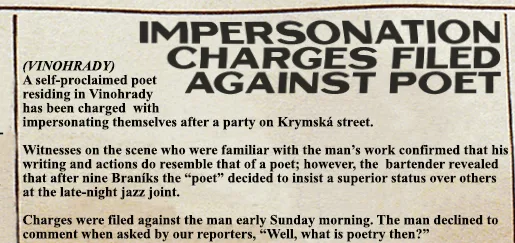
“Impersonation charges filed against poet.” From the Excuse Me, Žižkov paper.
Language happens as implication, which may or may not match its intention. If what is experienced is not as intended, then one of two reasons is likely given: either the audience does not understand the language of the performer, or the performer does not understand the language of the audience. Misunderstanding may lead to miscommunication, and miscommunication may lead to alienation—but it doesn’t have to. Miscommunication can be an opportunity for new understanding. We encourage everyone in the moment to approach (mis)communication as an opportunity to observe the personal subjective and to celebrate the collective connotative forces which shape our experience.
The significance of the Manifesto exists in the notion of inside jokes. Inside jokes require—and reward—active interpretation. They provide language users the opportunity to recognize that a past, shared convention derived from their unique microculture has been applied and appropriated into the present context—resulting in an articulate and acute affirmation of their shared understanding of past and present. The inside joke excludes not on the plane of convention, but on the plane of context—by language from shared experience, appropriated, celebrated, and made present—“you had to be there.”
OBJECT:PARADISE curates moments where these micro-understandings can be found and created together, where the shared context itself becomes the foundation of community. In these moments, we can observe language happening and celebrate its connotative forces as a communal act.
To celebrate a language happening is to open up our senses to everything occurring in the objective moment: sound, action, language, and physical space. Again, the poetry reading at the wedding and at the funeral taste different.
With some orchestrated performances of sound, action, and language, unorchestrated happenings may be taken as planned, or experienced as potentially poetic.
Someone laughs. With him? At him? The laugh, too, is an opportunity to understand what the laugh means.
When the question “Is this part of the performance?” becomes “Might I find this poetic today?”, the subject of subjectivity asserts its agency.
It is when this happens that we know we have provided a context for the subjective world to be experienced in the objective moment.
The OBJECT:PARADISE Manifesto was originally curated by Tyko Say, Sandra Pasławska, Jaromír Lelek, and Roksan Mandel in Žižkov, Prague, Czech Republic, in 2020. Our founding document is composed of twenty mantras which inform all actions, projects, and curations by the OBJECT:PARADISE collective.
Manifesto Mantras
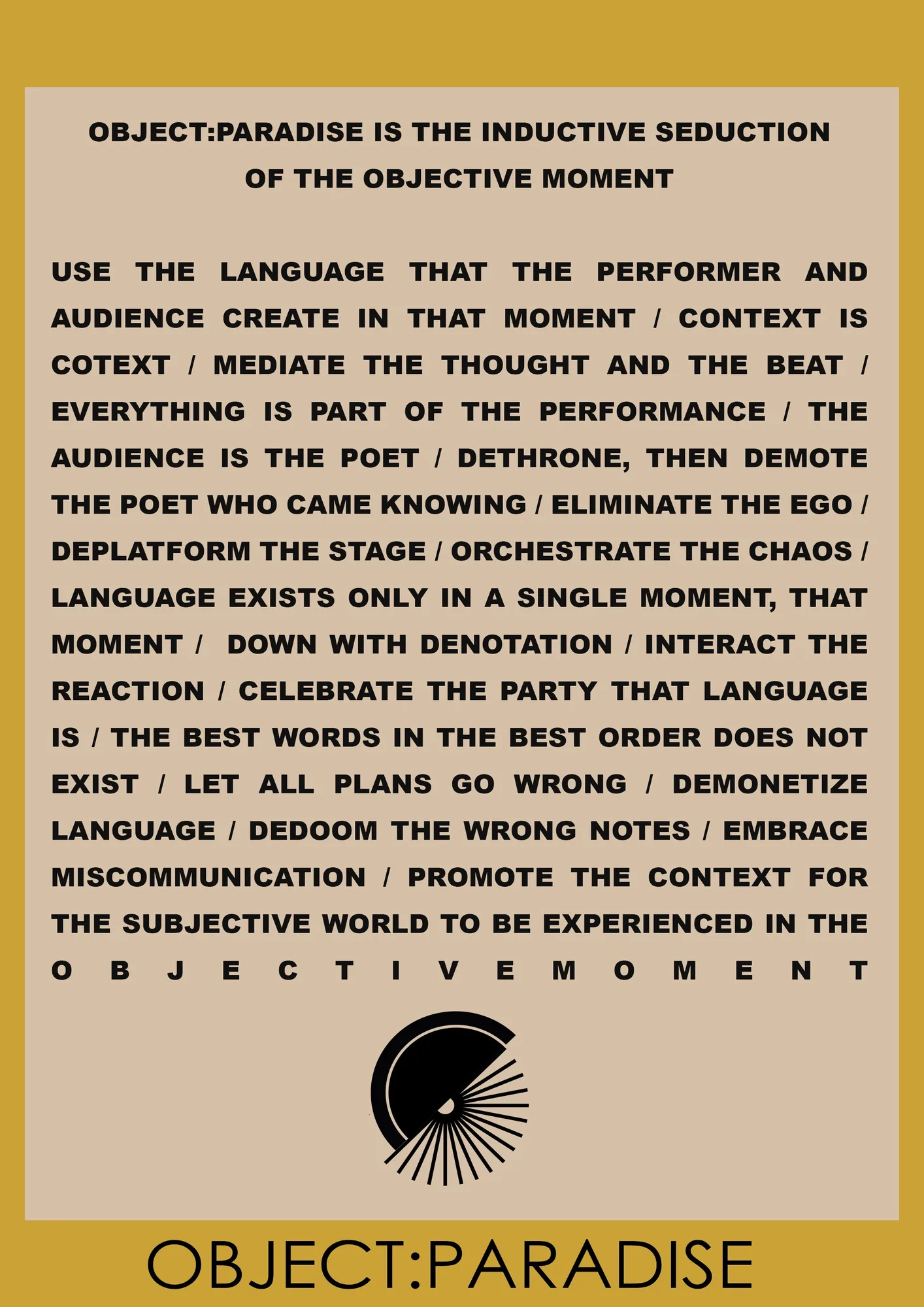
OBJECT:PARADISE IS THE INDUCTIVE SEDUCTION OF THE OBJECTIVE MOMENT
USE THE LANGUAGE THAT THE PERFORMER AND AUDIENCE CREATE IN THAT MOMENT
CONTEXT IS COTEXT
MEDIATE THE THOUGHT AND THE BEAT
EVERYTHING IS PART OF THE PERFORMANCE
THE AUDIENCE IS THE POET
DETHRONE, THEN DEMOTE THE POET WHO CAME KNOWING
ELIMINATE THE EGO
DEPLATFORM THE STAGE
ORCHESTRATE THE CHAOS
LANGUAGE EXISTS ONLY IN A SINGLE MOMENT, THAT MOMENT
DOWN WITH DENOTATION
INTERACT THE REACTION
CELEBRATE THE PARTY THAT LANGUAGE IS
THE BEST WORDS IN THE BEST ORDER DOES NOT EXIST
LET ALL PLANS GO WRONG
DEMONETIZE LANGUAGE
DEDOOM THE WRONG NOTES
EMBRACE MISCOMMUNICATION
PROMOTE THE CONTEXT FOR THE SUBJECTIVE WORLD TO BE EXPERIENCED IN THE OBJECTIVE MOMENT
OBJECT:PARADISE keeps only what it needs to run the archive: sign-in, player and room preferences. No tracking cookies. If you agree, we also use Google Analytics to understand traffic. Do you agree to analytics?
Only what the archive needs is stored. Optional analytics? Privacy policy
Add OBJECT:PARADISE to your home screen — the archive, one tap away.
Tap in the toolbar, then Add to Home Screen.
HOW SHOULD WE REACH YOU?
The archive is quiet by design. Choose what's worth an email — you can change any of this later in Settings.
DIRECT MESSAGES
SET UP YOUR PROFILE
This is how the community finds you. Everything here is optional and editable later from your profile.
Creating your account
Your profile picture
Put a face to the name, or don't — you can add one later from your profile. Nobody on the archive is anonymous by accident.
Drop your profile picture here
Or choose one from your device. You'll place it on the next screen.
Consulting the archive
Drag to place
Avatar
Your profile picture is yours to change or remove at any time, from your profile. It is not published anywhere until your account is created.
THE O:P COMMUNITY MAP
The community map exists so members can find each other when they travel — you land in a city, you see who's there. Would you like to appear on it?
Only your city is ever shown — never an address, never coordinates you didn't type. You can opt out again at any time, from the map itself or from Settings.
WELCOME TO O:P
✓
·CONNECTIONS
·TAPES
O:P
Curatorial Request
ONE STEP LEFT
Confirm your email address.
Your account exists, but we haven't heard back from your inbox yet — so you cannot open settings, archive and photographs yet, and nothing you post or save would be kept. Click the link in the email we sent to your address, then press the button below.
Nothing there? It can take a minute, and it lands in your junk or spam folder more often than it should. Look there, press “Not junk”, and only then resend.